“Complete and balanced” is not empty marketing language. It has a specific nutritional meaning—and it is one of the first things to check when a food will make up your dog’s primary diet.
But we do not believe the words should end the conversation. A nutrient standard and a food philosophy answer different questions. Thoughtful feeding makes room for both.
What the words actually mean
AAFCO explains that “complete” means the food contains all required nutrients, while “balanced” means those nutrients are present in the correct ratios. The nutritional adequacy statement also identifies the species and life stage the claim covers.
A label may say the food was formulated to meet an AAFCO nutrient profile, or that animal feeding tests using AAFCO procedures substantiate its adequacy. Those are different substantiation methods. Neither means that AAFCO personally tested, certified, or “approved” that brand; AAFCO specifically says there is no such thing as an AAFCO-approved pet food.
What “complete and balanced” does not tell you
The claim addresses nutritional adequacy. By itself, it does not rank foods by freshness, ingredient sourcing, moisture, calorie density, degree of processing, protein variety, or how well one individual dog will do on the recipe.
Two foods can both carry a complete-and-balanced statement while looking very different in the bowl. One may be dry and highly processed; another may be frozen, moist, and made from recognizable ingredients. The designation matters in both cases, but it does not make the foods identical.
Our food-first way of looking deeper
At Goose’s Good Eats, we start with adequacy and then keep asking questions. What ingredients provide the protein and fat? How much moisture is present? Which ingredients are there for a nutritional purpose? How concentrated are the calories? How was the food made? Does the recipe suit this dog’s age, health, activity, digestion, and preferences?
We do not treat fat as a villain, and we do not assume every carbohydrate-containing ingredient is harmful. We look at the recipe as a whole. Fat supplies concentrated energy and essential fatty acids; its amount still has to fit the individual dog. Carbohydrate is not normally listed as its own line in the guaranteed analysis, so owners may need to look more closely at the ingredient list and ask what role starch-heavy ingredients play.
This is where the integrative, whole-food conversation adds value: meeting nutrient needs while also caring about ingredient transparency, purposeful variety, moisture, and the amount of processing between the source ingredient and the finished bowl.
The perspectives behind those questions
Our Journal is informed by several voices in fresh and biologically appropriate feeding. They do not agree on every detail, and their work is not a replacement for the regulatory definitions above. Together, they encourage a more curious look at the bowl.
Karen Becker, DVM & Rodney Habib
They emphasize minimally processed, species-appropriate real food, longevity, and practical ways to improve a dog’s bowl—even when a family is not ready to replace every meal. Becker is a veterinarian; Habib is a non-veterinary educator and author.
Judy Morgan, DVM
Her approach centers fresh whole foods, individualized plans, food therapy, and properly balanced homemade or commercial meals rather than one routine for every dog.
Dr. Conor Brady
He challenges starch-heavy, highly processed feeding and argues for a protein-forward, biologically appropriate raw approach grounded in canine physiology. He is not presented here as a veterinarian.
Steve Brown
His work pairs ancestral feeding patterns with formulation precision—especially thoughtful fat balance, minerals, fresh-food additions, and achievable improvements to an existing diet. Brown is not a veterinarian.
Ian Billinghurst, BVSc
His evolutionary raw-feeding framework emphasizes raw meaty bones, animal foods, and whole-food variety as the foundation of a biologically appropriate diet.
A note on perspective: These are influential viewpoints, not a claim that these educators endorse Goose’s Good Eats or that every idea represents veterinary consensus. Medical needs and major diet changes should be discussed with a qualified professional who knows your dog.
Five questions to ask before choosing a food
- 01Does it say complete and balanced?
If it will be the whole diet, find the nutritional adequacy statement rather than relying only on front-label wording.
- 02Which life stage does it cover?
Adult maintenance, growth, reproduction, and all life stages are not interchangeable claims.
- 03What provides the nutrition?
Read the ingredient list and guaranteed analysis together. Neither tells the entire story alone.
- 04How calorie-dense is it?
Frozen, dry, and air-dried foods can provide very different calories per ounce. Portion by calories, not appearance.
- 05How is your dog responding?
Body condition, stool, appetite, coat, energy, and medical needs matter. Personalized veterinary guidance matters when health conditions are involved.
How our foods are labeled
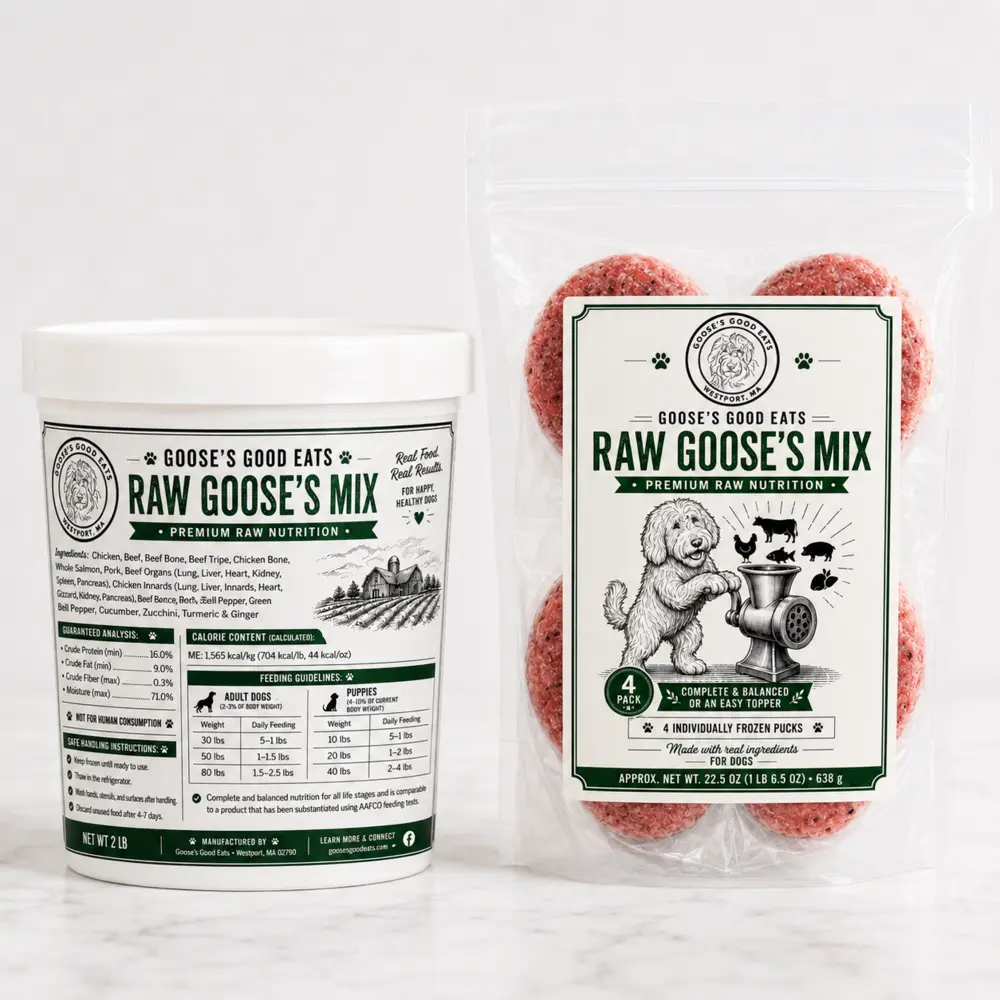
Goose’s Mix, Surf & Turf Feast, Coast & Coop, and Air-Dried Surf & Turf Feast are presented as complete-and-balanced options according to the life-stage statement on each current package. Coast & Coop, for example, is formulated for adult maintenance.
Other foods have a supporting role. Beef 80-10-10, Veal & Lamb Blend, and our Bowl Boosters can bring protein variety, flavor, moisture, or whole-food ingredients to a bowl, but they are not automatically complete diets by themselves.
The takeaway
Complete and balanced should be a starting requirement when a food is the whole meal—not a reason to stop reading. Check the life stage, calories, ingredients, intended use, and current label. Then choose the form of food and feeding philosophy that makes sense for the dog you actually live with.